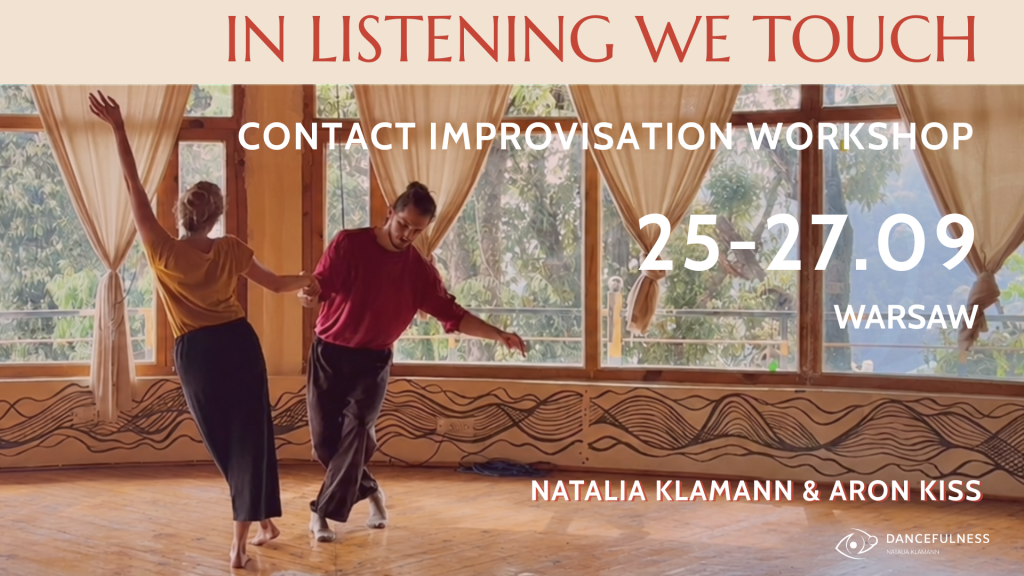
In Listening We Touch

A Contact Improvisation weekend workshop exploring how attention transforms movement, technique, and connection.

“Tension masks sensation.” This simple insight reminds us that the more we become occupied with doing, controlling, or achieving a particular outcome, the less we are able to perceive what is already present.

Warsaw. 26-27. 09

Book your spot here: https://forms.gle/BygjDi3HK87mz83t8

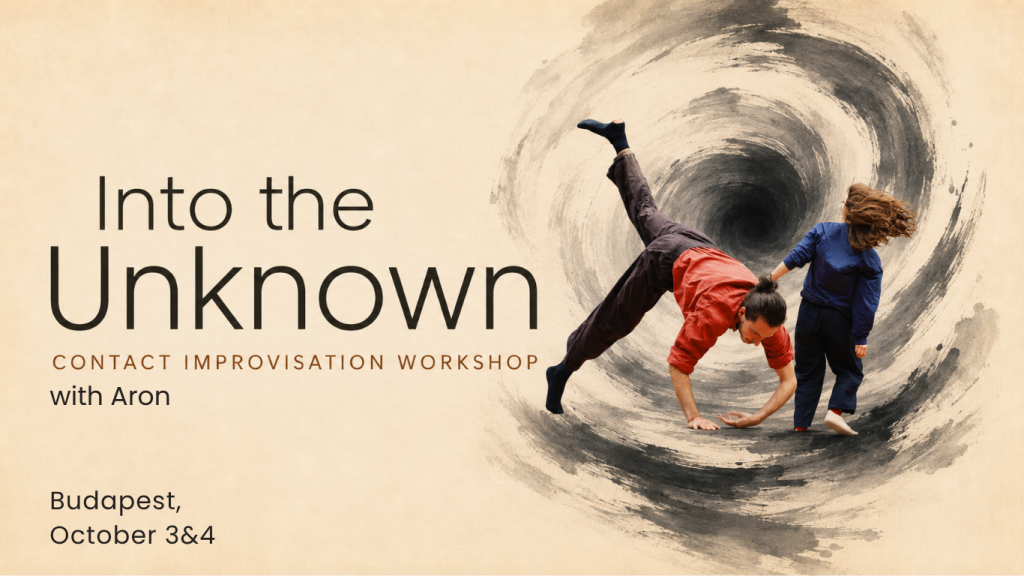
Into the Unknown

What happens when we step outside our familiar patterns, our habitual ways of moving, relating, and responding? In life as well as in dance, we tend to keep repeating known movements, known rhythms, and known relational dynamics. While these patterns offer a sense of safety, they can also limit spontaneity, creativity, and authentic connection. This workshop explores what it means to move beyond these habitual “scripts” and step into the unknown.

SíN Arts Centre
1139 Budapest, Gyutacs u. 10.
Schedule:
October 3-4
Saturday: 11:00–13:30, 15:30–18:30
Sunday: 11:00–13:30, 15:30–18:30

Details and Registration: https://fb.me/e/7FyZaonUN

Vipassana Retreat – Event

Vipassana Retreat

10-Day Satipatthāna Vipassanā Silent Retreat in the Mountains of Dharamsala. Led by Ajahn Mike, former monk and meditation teacher.
Daily group meditations along with talks and individual interviews with each participant, where the practice gets adjusted to what’s actually arising for that person. One-on-one guidance is available throughout. 
It is a chance for beginners as well as advanced practitioners to receive personal advice and guidance in their practice in an environment that is dedicated just for this.

Spots are limited and registration is required.
Application deadline is August 25th.

Details and Registration

Shakti Rising – Event

Shakti Rising

Explore deeper aspects of yoga beyond regular asana practice, including pranayama, meditation, subtle body awareness, the chakras, in a safe and grounded way. Enter the philosophical and devotional dimension of Shakti through bhajans, kirtan, mythology, and stories of Devi, the Divine Mother.

with Angelika & Aron

Manas Yoga Studio, Vienna
September 13th, 2026
18:00 – 21:00

Details and Registration

The Yoga of Dance – Event

The Yoga of Dance

A workshop inspired by the principles of yoga, authentic movement, contact improvisation, and embodiment.


Manas Yoga Studio, Vienna

September 12th, 2026 

18:00 – 21:00


Details and Registration

Healing through the Unknown

Healing through the Unknown – Content

I would like to begin this discussion by clarifying a few things about the title. The word healing in the title, and throughout the rest of this text, will refer to experiences that bring a positive shift into the human system—into both body and mind. I am referring to experiences that create a lasting impact and possibly a shift in perspective. This kind of healing is not necessarily the solution to a particular problem, but rather an event or process in which the cause of a problem is seen with such depth and clarity that the problem either ceases to exist or transforms into something supportive rather than destructive.

The thesis of this text is that such healing can most easily occur through entering the unknown. By unknown I mean a state of improvisation: entering a process in which there is no fixed goal and no predetermined steps, a state in which every moment is encountered anew and experience is met through fresh eyes rather than through the filters of habit, memory, and expectation.

To explore this possibility, I will draw from several fields that approach the unknown from different perspectives.

Vipassana meditation offers a way of meeting experience directly, before it is shaped by concepts and judgments. Contact Improvisation explores what becomes possible when movement and relationship unfold without predetermined patterns. Aikido demonstrates how responsiveness can emerge from harmony with changing circumstances rather than from control. Developmental psychologist Daniel Stern’s work on the present moment investigates how transformation often occurs within spontaneous lived experience rather than through abstract understanding alone.

My understanding of these subjects has been shaped through practice as well as study. I have had the opportunity to practice Vipassana meditation within both the Burmese and Tibetan Buddhist traditions under teachers such as Sayadaw U Tejaniya and Mingyur Rinpoche. I have also practiced Contact Improvisation with teachers including Dolores Dawhurst, Sasha Dodo, Kirstie Simpson, and many others. In addition, books such as The Present Moment by Daniel Stern, In Kinship with All Life by J. Allen Boone, and Aikido and the Harmony of Nature by Mitsugi Saotome have contributed significantly to the development of this research.

In this text, I will explore the hypothesis that states of uncertainty, spontaneity, and direct experience may provide particularly fertile conditions for lasting psychological transformation and healing. Drawing from contemplative practice, movement-based improvisation, developmental psychology, and martial arts, I will examine how encounters with the unknown can facilitate forms of change that are difficult to achieve through deliberate control, conceptual understanding, or predetermined methods alone.


The Issue – Starting Point

Any investigation into healing must begin with an examination of the conditions that make healing necessary. One of the most consistent features of human experience is the presence of dissatisfaction, conflict, and psychological distress. Although these experiences manifest in countless forms, they point toward a common observation: we often struggle not only with the challenges presented by life, but also with our relationship to those challenges.

While external circumstances undoubtedly influence well-being, many forms of psychological suffering appear to arise not directly from events themselves, but from the ways in which those events are perceived, interpreted, resisted, or identified with. Two individuals may encounter similar circumstances and yet experience them in profoundly different ways. This suggests that suffering cannot be understood solely as a consequence of external conditions, but must also be examined as a function of the relationship between an individual and their experience. If this is the case, then healing cannot be reduced merely to the modification of external circumstances. Rather, healing may involve a fundamental transformation in the way experience itself is perceived and related to. Such a transformation would not necessarily eliminate difficulty, uncertainty, or pain from life, but it could alter the patterns through which these experiences become sources of persistent psychological suffering.

This observation occupies a central position within Buddhist thought. The Buddha’s first teaching, commonly referred to as the First Noble Truth, begins with the recognition that suffering/dissatisfaction is an inherent feature of human existence. However, suffering in this context does not refer solely to physical pain or extraordinary hardship. It encompasses a more subtle and pervasive sense of dissatisfaction: the feeling that our experience is incomplete, unstable, or somehow at odds with how one
wishes it to be.

The persistence of this dissatisfaction raises an important question. If we possess remarkable capacities for learning, adaptation, and problem-solving, why do certain forms of suffering continue despite repeated attempts to overcome them? Why do familiar patterns of thought, emotion, and behavior often reappear even when they are recognized as
harmful? One possible explanation is that many attempts at change occur within the same conceptual and behavioral frameworks that produced the difficulty in the first place. Rather than encountering experience in a fundamentally new way, individuals often respond to suffering through habitual strategies of avoidance, control, resistance, or distraction. While these strategies may provide temporary relief, they do not necessarily address the underlying patterns that sustain the problem.

A significant challenge in psychological transformation is that the mechanisms which sustain suffering often operate beneath conscious awareness. Even when a pattern has been recognized intellectually, it may continue to shape behavior in more subtle forms. As a result, efforts at change can inadvertently reproduce the very dynamics they are intended to overcome.
A clear example of this can be found in meditation practice. Within Buddhism, craving is often identified as one of the primary causes of suffering. However, understanding this intellectually does not necessarily free an individual from craving and aversion. In my own meditation practice, I frequently observed that although I understood craving to be the cause of dissatisfaction, my attempts to meditate were themselves driven by it. I would sit down with the intention of observing my experience, yet beneath that intention was often an implicit preference for a particular outcome: greater calm, concentration, mindfulness, or peace.
Although these aspirations may appear harmless, they were frequently accompanied by a subtle dissatisfaction with the present experience and a desire for it to be different from what it was. In this sense, the object of craving had changed, but the underlying pattern remained intact. Rather than observing craving directly, I was often enacting it through my efforts to overcome it.

This example illustrates a broader difficulty in processes of psychological transformation. Even when individuals possess accurate conceptual understanding of a problem, this understanding does not necessarily translate into a different mode of engagement with present experience. The structure of intention itself may already be shaped by the very
patterns it seeks to transform. As a result, efforts at transformation may remain constrained by the assumptions, habits, and modes of perception they seek to transcend. New solutions are sought, yet they are often approached through familiar ways of seeing, thinking, and responding. The content of experience may change, while the underlying structure through which experience is related to remains largely intact. In such cases, transformation cannot be fully accounted for at the level of ideas or intentions alone, but must also be examined at the level of how experience is being directly encountered in the moment.
This raises an important question: If the mechanisms that sustain suffering are embedded in everyday perception and in the way we relate to experience, what conditions would allow these patterns to be recognized and transformed without simultaneously reproducing the same habitual mode of relating to experience?

What happens when we don’t know what’s happening

In the next section, I will attempt to discuss the notion of the unknown, in which I believe that the solution to the previously discussed problem may be found. However, given that the unknown, by definition, cannot be fully captured through conceptual description, I will not attempt to define it directly. Instead, I will approach it through practices that have the potential of leading one into the unknown. The primary practices I will draw from are Vipassana meditation, also known as insight meditation, and Contact Improvisation. To begin, I will describe the practice of Vipassana in more detail, as it provides a useful framework for understanding how sustained attention to present-moment experience may allow for a different mode of perception to emerge.
In Vipassana meditation, the practitioner observes phenomena arising continuously from moment to moment. Unlike concentration-based practices that emphasize a single object of attention, Vipassana involves an increasingly inclusive awareness of whatever arises in experience, including bodily sensations, thoughts, emotions, and perceptions. These phenomena are observed without selectively prioritizing one over another or imposing a deliberate preference for particular experiences.
The aim of the practice is not to produce a specific state, but to develop direct insight into the processes by which experience is constructed moment by moment. In this context, a key aspect of the practice is the observation of how raw sensory data is rapidly interpreted and organized into conceptual meaning. For example, a sound may arise as an immediate sensory impression, which is then quickly categorized for example as “a bird singing outside the window.” In this transition, a direct sensory event is transformed into a conceptual representation. Vipassana practice involves observing this process without reinforcing the interpretive layer that automatically attaches meaning, narrative, or conceptual labeling to experience.

While in ordinary cognition the mind tends to generate continuous interpretations of sensory input, the practice involves noticing these interpretations as they arise, rather than fully identifying with them. From this perspective, the intention is not to eliminate meaning from experience in everyday life, but to examine a mode of perception in which experience is not immediately organized into narrative or conceptual structure. This allows for the possibility of observing experience at a more
immediate level, prior to interpretive elaboration. Through sustained practice, Vipassana can therefore be understood as a method for exploring a mode of awareness in which experience is continuously observed as it arises, without immediate conceptual fixation. This allows the practitioner to enter a state of “not knowing,” in which attention is directed less toward the content of the experience and more toward the processes through which experience is constructed.

The second example I would like to draw on to further demonstrate how one can enter into the unknown is Contact Improvisation.
Contact Improvisation was initiated in 1972 by the American choreographer Steve Paxton. Its roots lie in the experimental spirit of modern dance, as well as in influences from Eastern movement practices such as Aikido and Tai Chi. From its beginning, it developed as a touch-based and non-prescribed form of collaborative movement, where attention is placed on bodily awareness, responsiveness, and relational movement rather than fixed choreography or pre-designed form.
Unlike many dance forms that are based on learning and reproducing fixed techniques or sequences, Contact Improvisation is primarily principle-based. This means that rather than aiming to master a specific set of movements, practitioners work with guiding principles that shape how movement emerges in real time. Principle-based practice involves continuous inquiry and responsiveness to both familiar and unfamiliar situations. It is a form of learning that takes place through direct experience, experimentation, and ongoing adjustment rather than through repetition of predetermined forms.

In this sense, it differs from training models that rely primarily on replication of expected outcomes. Instead, it emphasizes the ability to remain attentive and adaptable within changing conditions. Within this framework, it is one thing to understand the principles intellectually, and another to embody them in real-time situations.
Practice gradually develops the capacity to recognize and apply these principles within the constantly shifting reality of improvisational movement. Importantly, this process is not considered something that can be completed; rather, it is understood as an ongoing and open-ended mode of inquiry.
Some of the core principles of Contact Improvisation include mutual care, shared responsibility, spatial awareness, listening, multi-directional reach and perception, moving from self-centerdness to shared-centerdness, responsiveness, and the exploration of mutual freedom through mutual dependence. A central aspect of the practice is also the suspension of fixed agendas, allowing movement to emerge through interaction rather than control. Taken together, these principles form a practical framework for engaging with uncertainty in real time. For the purposes of this investigation, Contact Improvisation will be considered as a concrete example of how embodied practice can provide access to modes of experience that are not governed primarily by conceptual planning or fixed intention, but by continuous responsiveness to what is unfolding in the present moment.

Although Vipassana meditation and Contact Improvisation originate from different contexts—one rooted in contemplative practice, the other in embodied movement research—they share a fundamental structural similarity. Both can be understood as practices that temporarily suspend habitual modes of control, conceptual planning, and fixed interpretive frameworks in order to allow experience to unfold in real time. What is significant for the present investigation is that both practices appear to create conditions in which habitual patterns can become visible as they arise, rather than being enacted unconsciously.

This visibility does not occur through conceptual analysis, but through a shift in the mode of engagement itself. Experience is no longer organized primarily around what is expected or intended, but around what is actually unfolding.
From this perspective, what these practices share is not a specific technique or goal, but a particular set of conditions under which experience is encountered in a less pre-structured way. It is precisely within this reduction of pre-structuring that a different quality of awareness becomes possible—one in which familiar patterns of perception and response can be observed without immediately determining the unfolding of experience. This shared condition may be described, provisionally, as a form of openness to the unknown. However, the “unknown” in this context does not refer to something mystical or abstract. Rather, it refers to the suspension of pre-established interpretive and behavioral certainty, allowing experience to present itself without being fully organized in advance by memory, expectation, or conceptual projection. From this perspective, both practices can be seen as training environments for a shift in the mode of relating to experience. This shift does not eliminate structure or meaning, but temporarily loosens their dominance, allowing alternative forms of perception and response to emerge. It is precisely this temporary suspension of habitual organization that appears to create conditions in which previously automatic patterns may become observable and potentially transformable.

Response-ability and Awareness

Now having explored practices that provide access to the unknown, it is now necessary to examine what remains when habitual modes of perception no longer dominate experience. Entering a state of not knowing does not imply the disappearance of memory, knowledge, or previously acquired understanding. Rather, it involves a temporary loosening of their automatic influence on perception. Experience is no longer filtered exclusively through habitual interpretations, thinking process, and expectations.What remains is awareness.

Awareness is a difficult thing to talk about. We possess countless words for describing thoughts, emotions, sensations, perceptions, and events, but awareness itself is not an experience. Rather than being something that is experienced, awareness is that through which experience is known. For this reason, awareness cannot be observed in the same way that one observes a thought, an emotion, or a sensation. And yet it remains ever-present. Without it, no experience could be known or perceived.Awareness therefore occupies a peculiar position: although it cannot be grasped as an object of experience, it is the condition that makes experience possible.

When speaking of awareness in the present discussion, however, I do not mean a passive witnessing of experience. Rather, I am referring to the capacity for clear perception—the ability to perceive what is unfolding from moment to moment without immediately imposing a narrative or conceptual framework upon it. In this sense, awareness and clarity are closely related. Experience becomes clearer not because more information is added, but because less is projected onto what is taking place. For the remainder of this text, the terms awareness and clarity will be used interchangeably.

Within many contemplative traditions, wisdom is considered an aspect of awareness. The capacity to perceive clearly and the capacity to respond appropriately are viewed as aspects of the same process. Awareness is therefore not merely receptive, it is also responsive.From this perspective, response-ability can be understood as an expression of awareness itself. The more clearly a situation is perceived,the greater the possibility of responding to it in a way that is harmonious with the reality of the moment rather than with pre-existing assumptions about it. The forms through which such responsiveness manifests may vary, but its source remains the same: a direct relationship with experience as it unfolds.

When perception is heavily influenced by preconceived ideas, expectations, or fears, our response is no longer directed solely toward what is actually occurring. Instead, it is directed toward a mixture of present reality and our interpretation of that reality. The greater the degree of distortion, the greater the possibility that our response will be disharmonious with the situation.

The central argument developed thus far is not that healing is produced by a particular technique, belief system, or prescribed method. Rather, it is that certain practices can create conditions in which habitual patterns of perception and response become visible. When these patterns are no longer enacted automatically, but are instead held within awareness, a different relationship to experience becomes possible.

From this perspective, the significance of practices such as Vipassana meditation and Contact Improvisation lies not primarily in the activities themselves, but in their capacity to cultivate clarity. By repeatedly inviting practitioners into situations where preconceived responses are insufficient, they encourage a direct encounter with experience as it unfolds. Within such encounters, awareness is no longer occupied solely with the content of experience, but begins to illuminate the processes through which experience is organized and understood.

If suffering is sustained through unconscious patterns of perception and response, then the capacity to perceive these patterns clearly may it self represent the beginning of their transformation. The possibility of healing,therefore, may not lie in acquiring something new, but in developing a different relationship to what is already present.


Meeting Other

Until this point, we have explored the possibility that suffering and psychological distress arise not only from the circumstances of our lives,but also from the way in which we relate to those circumstances. We have seen that attempts at transformation often remain limited because the very perspectives through which change is sought are them selves shaped by the patterns they seek to overcome.

For this reason, we explored practices that create conditions in which habitual modes of perception can loosen. Through the examples of Vipassana meditation and Contact Improvisation, we examined how entering into a state of not knowing—a state in which familiar assumptions, expectations, and automatic responses no longer dominate experience—can open the possibility for new ways of perceiving and relating. We further explored how such conditions can cultivate awareness and clarity, allowing experience to be met more directly rather than primarily through the filters of memory, habit, and interpretation. From this perspective, awareness is not merely a passive observation of experience. It is a living process through which situations can be perceived with greater clarity, making possible responses that are more harmonious with present conditions. Rather than reacting from established patterns, one becomes increasingly capable of responding to what is actually taking place.

Having established these foundations, I would now like to turn toward a more immediate and familiar domain of human experience: our relationships with one another. Relationships provide a particularly relevant context for this exploration because they are both universal and deeply consequential. Most of us know from experience that relationships can be a source of great suffering and pain but we also know that they can become a source of healing, growth, and transformation.It is therefore within the field of human relationship that many of the themes explored thus far become directly observable. The dynamics of perception, interpretation, awareness, habitual patterns, and responsiveness are not merely abstract concepts; they are continually expressed in the way we encounter and relate to other people. By examining relationships more closely, we may gain a clearer understanding of how the processes discussed throughout this text operate in everyday life.

To explore the role of relationship more closely, it may be useful to begin with the very moment a relationship begins: the subtle and often unnoticed transition between not knowing someone and knowing them. Everything we encounter is filtered through the mind. The way we think about something influences the way we experience it, and the way we experience it, in turn, reinforces the way we think about it. Thought shapes experience, and experience reinforces thought. Over time, this process can become self-perpetuating, giving rise to what Buddhist traditions describe as samskaras or vasanas—habitual patterns that influence perception, interpretation, and behavior.

“Thou shalt decree a thing, and it shall be established unto thee, and the light shall shine upon thy ways.”— Job 22:28

When another person enters our experience they first appear as an image, an impression, or an idea within our own mind. Before we relate to another person directly, we relate to our perception of that person. The moment another human being crosses the boundary between our not knowing and our knowing, a subtle but significant process begins.

From that point onward, the way we define, interpret, and relate to that person becomes our responsibility. If we are not attentive, our relationship may become shaped primarily by assumptions, past experiences,inherited beliefs, and second-hand information. For this reason, there is value in approaching each encounter with a certain openness, allowing space for the possibility that the other person may be more than our ideas about them.Who another being turns out to be for us is nothing more or less than our thoughts and attitude towards that being made manifest in our outward experience.

The images we form of other people do not arise in isolation however. They are intimately connected to the images we hold of ourselves.The way we perceive another being is influenced not only by who we see them to be, but also by who we believe ourselves to be. Consciously or unconsciously, we understand others in relation to our own identity, preferences, fears, desires, and expectations. The image we create of another person therefore reveals something not only about them, but also about ourselves.

This has important implications for relationship. If our perception of another person is shaped by our own self-image, then difficulties within relationships cannot always be understood solely by examining the other person. They may also require us to examine the assumptions,attachments, and identifications through which we perceive them.Seen in this light, relationship becomes more than an encounter with another human being. It becomes an opportunity to observe the processes through which both self and other are continually being interpreted, defined, and brought into experience.

If this is the case, then the quality of our relationships may depend less onour ability to understand another person conceptually and more on our capacity to meet them directly. This raises a question that is central to the present discussion: How is it possible to relate to another person without being completely governed by the assumptions, expectations, and narratives through which we ordinarily perceive them?

The practices discussed earlier in this text could give us the answer. Justas Vipassana meditation invites us to observe experience without immediately becoming absorbed in our interpretations of it, and just as Contact Improvisation invites us to respond to what is actually occurring rather than what we expect to occur, relationship may also be approached as a process of ongoing discovery rather than confirmation. This does not require the abandonment of memory or prior knowledge. Rather, it involves a willingness to hold such knowledge lightly enough that it does not prevent us from perceiving what is actually taking place. To meet another person in this way requires a certain openness: a temporary suspension of certainty about who they are, who we are, and what the interaction is supposed to become.

Much of the time, however, we are occupied by our own thinking. We wait for our turn to speak, seek confirmation of existing beliefs, or relate to others primarily through our own needs, fears, and desires. In doing so, we may unknowingly reduce the other person to a role within our own narrative rather than encounter them directly.

Yet it is precisely within the willingness to let go of such narratives, even fora moment, that a different quality of relationship may emerge.From this perspective, relationship becomes another field of improvisation. Just as in Vipassana meditation or Contact Improvisation,there is no fixed script to follow, there is only the unfolding reality of the present moment and the invitation to meet it directly.

When two people are able to suspend, even temporarily, some of their assumptions, expectations, and habitual narratives, something remarkable can occur. The encounter is no longer organized primarily around who each person believes themselves to be or who they believe the other person to be. Instead, attention becomes available for what is actually taking place between them.

There is already something profoundly transformative in such moments. Before any problem is solved, before any insight is reached, and before any attempt is made to change another person, there is the simple fact of sharing an experience together. To be deeply heard, to listen deeply, and to participate fully in a shared moment of experience may itself be a movement away from the isolation that often is the cause of suffering.

It is here that the work of Daniel Stern becomes particularly relevant. Stern introduced the concept of intersubjective consciousness, which he described as follows:

“When two people co-create an inter subjective experience in a shared present moment, the phenomenal consciousness of one overlaps and partially includes the phenomenal consciousness of the other. You have your own experience plus the other’s experience of your experience as reflected in their eyes, body, tone of voice, and so on. Your experience and the experience of the other need not be exactly the same. They originate from different loci and orientations. They may have slightly different coloration, form, and feel. But they are similar enough that when the two experiences are mutually validated, a ‘consciousness’ of sharing the same mental landscape arises.”

From the perspective of the present discussion, the significance of such moments lies not only in mutual understanding, but also in the emergence of new possibilities. When experience is held within a shared field of awareness, perspectives, meanings, and responses can arise that might never have emerged from a single point of view. The encounter becomes creative. Something genuinely new becomes possible.

This is one of the reasons relationships may possess such transformative potential. When approached with openness, awareness, and a willingness to remain in the unknown, relationship becomes more than an exchange between two separate individuals. It becomes a space in which new waysof perceiving, understanding, and relating can emerge—ways that neither person could have fully predicted in advance.

Stern’s work also highlights another important point. The moments that bring about genuine change are not merely moments of intellectual understanding. Most psychotherapeutic approaches agree that transformative change occurs most powerfully within lived experience—in the “here and now”. It is here that mutually aware contact between individuals becomes possible.

The same principle extends beyond the therapeutic setting. Many of the moments that alter the course of our lives are recognized as significant not only in retrospect, but while they are occurring.If relationship is understood as a field of improvisation, then both individuals are invited into this living present moment together.

They are not merely exchanging ideas about experience; they are participating in experience itself. This distinction is important. Verbal explanation, analysis, and understanding may be valuable, but they are rarely sufficient on their own to produce deep transformation. Change is rooted in lived experience.

An event must be experienced directly. It must involve feeling, perception,action, and participation in real time. It must be lived rather than merely described. Sometimes such moments appear in simple forms: looking into the eyes of another person, taking a deep breath while speaking with someone, or sharing a moment of silence together. These may seem insignificant from the outside, yet they are experiences rather than ideas about experience. They are moments in which awareness, relationship, and presence meet.

From this perspective, the transformative potential of relationship arises from the quality of awareness brought into the encounter and from the willingness of those involved to participate fully in the unfolding reality of the present moment.
Yes, and…

As this exploration draws toward a close, I would like to refrain from presenting any final conclusions. Such restraint is not simply a matter of academic caution, rather it follows directly from the central themes of this inquiry.

Throughout this essay, I have attempted to examine the possibility that healing, transformation, and new ways of relating become available when habitual patterns of perception are loosened and when individuals are willing to enter the uncertainty of direct experience. If this possibility holds any truth, then it would be contradictory to conclude the discussion with a fixed answer or definitive formula. The spirit of this exploration has not been to arrive at certainty, but to remain open to discovery.

What has emerged repeatedly throughout this discussion is the observation that many of the qualities explored here—awareness,connection, improvisation, creativity, healing, and even insight itself—cannot be forced into existence. One may try to be aware, to listen, to connect, or to understand, but these qualities do not seem to arise through willpower. The moment a particular outcome becomes the primary objective, attention can become narrowed by that objective. In seeking to arrive somewhere, we may overlook possibilities that lie outsideour expectations. In this sense, the unknown cannot be entered through force. It can only be approached through openness. In the same way that darkness does not need to be pushed out of a room but disappears when light appears, unbeneficial patterns may not always need to be fought against directly but in the presence of awareness they lose their hold and power automatically.

I would also like to point out an important distinction. Healing does not occur because we arrive at the unknown. Rather, the very movement toward the unknown already contains the qualities that healing requires. To enter the unknown is to loosen one’s attachment to conclusions, expectations, fixed identities, and habitual ways of relating to experience. It is to suspend, even temporarily, the struggle to make reality conform to our preferences and to meet experience more directly as it is.

From this perspective, the process of creating the conditions discussed throughout this essay is not separate from healing itself. It is already an expression of it. What further possibilities may emerge from such conditions remains an open question and an ongoing field of inquiry. However, whenever awareness deepens, whenever conflict with experience softens, and whenever there is a willingness to remain present with what is currently unfolding, new ways of perceiving, relating, and living may become available. The invitation, therefore, is not to accept these ideas as conclusions, but to explore them within one’s own experience.

Thank you,
Aron

Privacy Policy

Legal Notice

Facilitator